
This picture conjures within me feelings of wistful longing.
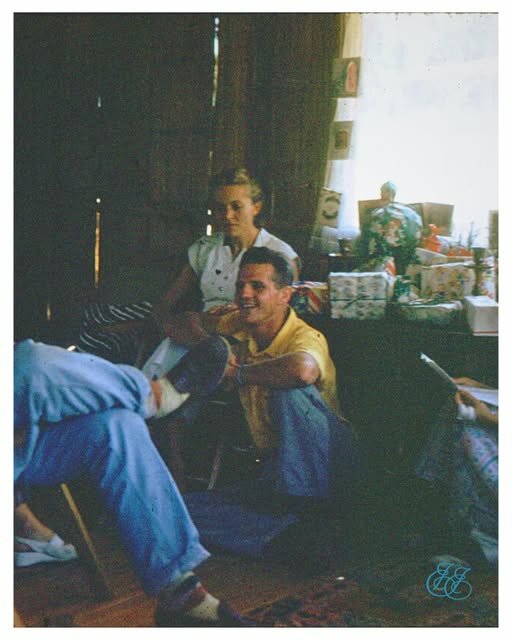
Pictured here, are Mr. and Mrs. Jim and Elisabeth Elliot. The year is not known (probably 1955), but clearly it’s a Christmas party. The location is somewhere in Ecuador.
If you don’t know who that couple is, it is my pleasure to introduce you. Jim and “Betty” met at Wheaton College when both were planning on going to the mission field. Jim felt very much called to the unreached tribes in South America, knowing only a little bit of the privation and peril that would await them. They were very much in love – but Jim wouldn’t marry Betty unless she learned the Quichua dialect. Which she did.
Both of them, along with four other missionary couples were led to establish a mission outreach to the Huaorani people – a tribal culture that was violent and unpredictable. There are two movies that every Christian ought to see, Through Gates of Splendor (which of course, is based on the book) and The End of the Spear, from the point of view of Steve Saint, the son of Nate Saint, one of the missionaries. I cut to the chase: those five men established contact with the Huaorani, and somehow landed a plane in their territory. Thinking they men were there to kill them, the struck first, killing all five men and destroying the plane. The story drew world-wide attention – even landing a photo spread on Life Magazine. Five widows with children now forced to try and navigate life on their own.
The picture causes me to pause and reflect.
Take Caution in Framing Christmas in Your Own Image
Perhaps the challenge for western culture is that for hundreds and hundreds of years, we’ve enjoyed certain cultural affects of Christmas that now takes considerable effort to parse into its intention. It's important to remember that Christmas does not belong to us. It is for us - but we don't own it. Even though it can be argued that it drives our consumer economy, the whole idea was literally other worldly. This makes it difficult because we have attachments to Bing Crosby singing “White Christmas”, Brenda Lee make us move to “Rockin’ Around the Christmas Tree”, and even – albeit, uncomfortably – Eartha Kitt purring “Santa Baby”. Then there are the movies. Who doesn’t love watching “It’s a Wonderful Life” or “Miracle on 49th Street” – even “Home Alone”? Back to the picture …
That picture of the Elliot’s is presumably the last Christmas that Jim and Betty shared together. She, 29, he 28. I can hardly bear to look at it thinking of what lay before them. Jim and four of his friends and co-missionaries would be murdered in January of 1956, leaving Betty and the other ladies alone to raise their children and try to navigate life. They traded in “the American Christmas Dream” for something different.
Was that trade better given that they’d never grow old with their young wives, never see their kids grow up and have families of their own, never experience what we think of as the “typical” family Christmas? To me, the import of the picture is that to them, even though they didn’t fully know it, was that indeed, it was a better bargain.
And in that is kernel of truth of Christmas. They knew the Huaorani would not be celebrating the virgin birth of God’s one and only Son to be the propitiation of their sins. They were more than willing to lay down their lives, if need be, for the Huaorani to experience – not a westernized Christmas – but for Christ to be born in their hearts. (Now you need to do some investigation and find out the rest of the story.)
At the very heart of Christmas is a strange, other-worldly, love.
This love so strong, the Father would gladly sacrifice pleasure in the short run to enjoy it eternally. This is what motivated young Jim and Betty Elliot to celebrate Christmas in Ecuador – and probably never celebrate it together, again.
For disciples, today, it is another reminder not only to resist the temptations of consumerism (in my opinion, the greatest threat to Christianity), but even keep a stern eye on the nostalgia of Christmas. If anything, Christmas ought to be a good reminder of a young Jim Elliot, who as a college student wrote in his journal: “He is no fool who gives what he cannot keep to gain that which he cannot lose.”
SDL